The FFI FAMER Project
FAMER – Facilitating Multi-Party Engineering of Requirements is a three-year Vinnova FFI-funded project that started on September 1, 2023. The project develops concepts, models, and techniques for building and managing requirements knowledge for safe AI-based automotive perception systems in a multi-party systems-of-systems context.
Safe perception-system development requires collaboration across multiple organisations, disciplines, tools, and lifecycle stages. FAMER addresses this challenge by improving how requirements are represented, aligned, validated, and shared across the automotive value chain in iterative and collaborative development settings.
The project is coordinated by the University of Gothenburg, in collaboration with Volvo Cars, Zenseact, Kognic, and RISE. Together, the partners represent key parts of the automotive perception ecosystem, spanning requirements engineering, safety engineering, perception-system development, and data annotation.
FAMER focuses on three main outcomes:
- a domain description and reference architecture for safe perception systems,
- an information model for managing requirements knowledge across multiple parties,
- and support for integrating requirements knowledge into multi-party agile development.
Partners and Roles
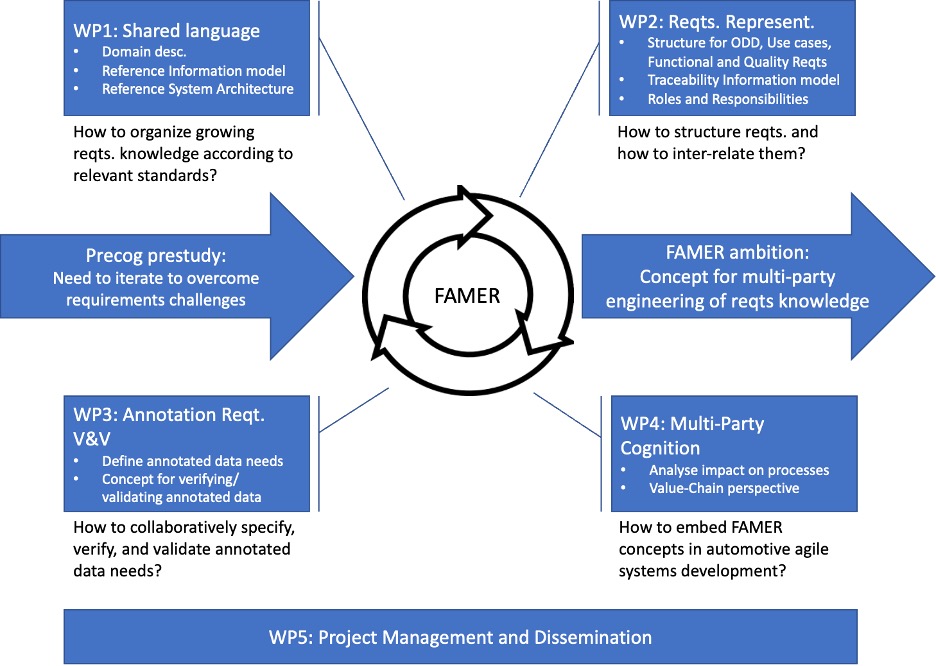
The University of Gothenburg coordinates the project and leads research on requirements representation and dissemination.
Volvo Cars leads the work on establishing a shared language and common foundation for the project.
Zenseact leads work on multi-party requirements cognition and supports integration into agile automotive development.
Kognic contributes expertise in data annotation, validation, and annotation-related requirements.
RISE contributes expertise in safety engineering, safety assurance, and dissemination.
Emerging Results
FAMER has already produced a growing body of results on requirements engineering for safe AI-based perception systems. The completed publications show a clear progression of results: understanding how requirements are represented across multiple stakeholders, establishing data annotation as a requirements engineering concern, identifying practical annotation-requirement and quality challenges in industry, and proposing structured approaches for annotation requirements representation and specification.
Recent results show that requirements representations in machine learning-based automotive perception systems must support communication and alignment across multiple stakeholders (S1., 2025). A second stream of results establishes data annotation as a requirements engineering concern rather than only a data-processing activity. It shows that annotation decisions directly affect whether system-level goals, safety expectations, and quality requirements can be fulfilled in machine learning systems (S3., 2025).
Together, these results show how FAMER is building both scientific knowledge and practical methods for improving traceability, collaboration, and quality across the automotive perception value chain. Further results details are available on the FAMER Publications page.
From Project Objectives to Industrial Achievements
FAMER set out to improve how requirements knowledge is built, represented, validated, and shared for safe AI-based perception systems developed across multiple organisations. Its objectives included establishing a shared language, improving traceability and requirements representation, strengthening annotation-related verification and validation, and supporting multi-party agile development in a systems-of-systems context.
The results achieved so far show clear progress toward these goals. FAMER has generated scientific and practical insights into requirements representations, data annotation requirements, annotation quality problems, and structured specification approaches. These outcomes demonstrate that the project is successfully translating its objectives into methods and knowledge that are relevant for industrial practice.
For the industrial partners, this has already created value. Volvo Cars has strengthened the foundation for shared understanding and requirement alignment. Zenseact has gained support for collaborative and iterative requirements work in distributed automotive AI development. Kognic has advanced its understanding of annotation requirements, validation data, and annotation-tool needs. RISE has strengthened its work on safety assurance, standards, and innovation support for safe perception systems.
These achievements show that FAMER is delivering not only expected research outcomes but also concrete industrial relevance across the automotive perception value chain.
Work Package Structure
Vision and Impact
FAMER aims to strengthen the ability of multiple parties to agree on, manage, and evolve requirements for safe perception systems. In the long term, this supports safer and more effective development of automated vehicle technology and strengthens Swedish automotive innovation through better vertical and horizontal integration across the value chain.
Contact
You can follow the project on the FAMER homepage.
For more information, contact Professor Eric Knauss at eric.knauss@gu.se.